API Paradigms: Choosing the Right Protocol for Your Application

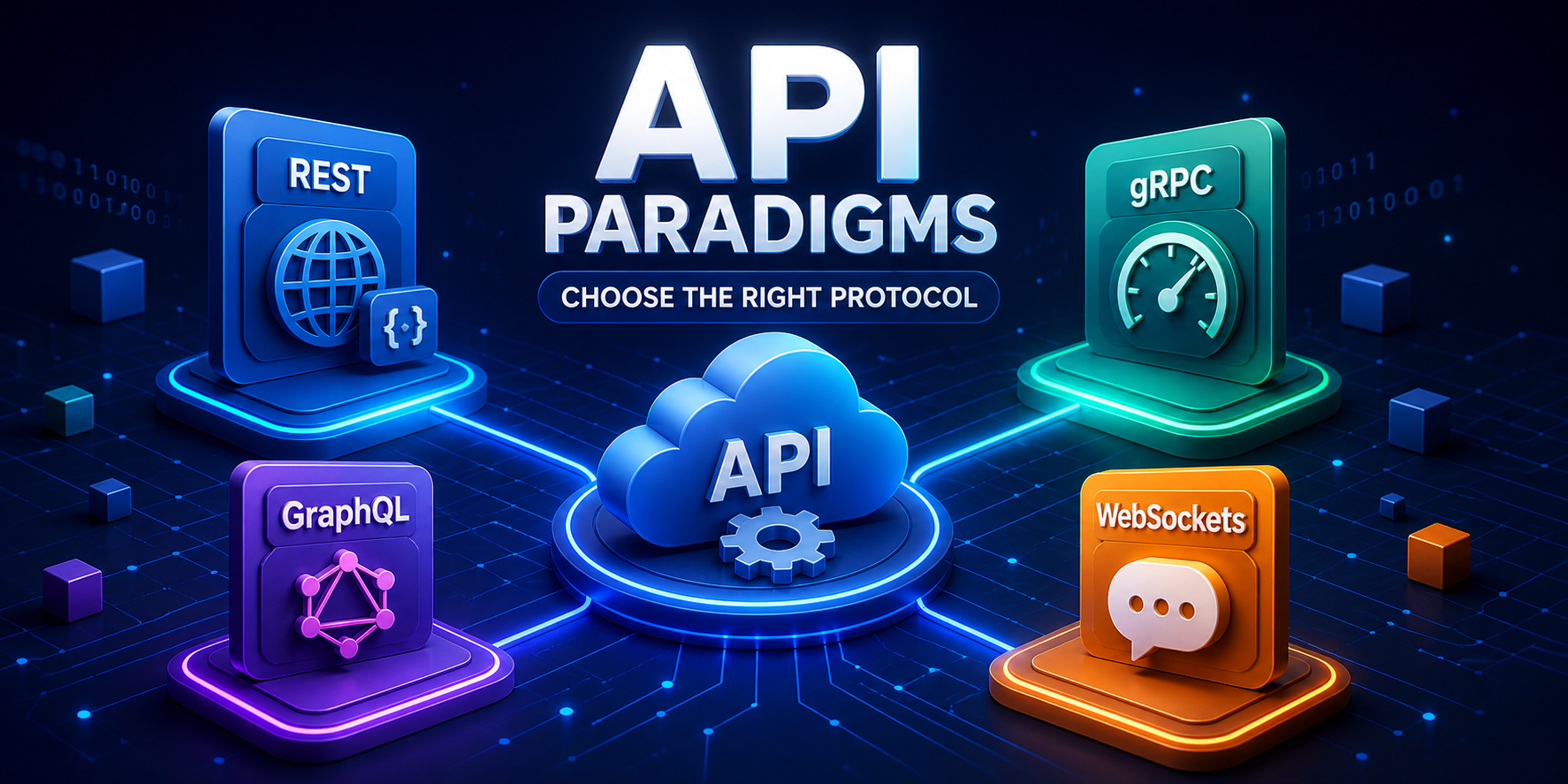
In the world of modern software development, the "one-size-fits-all" approach to API design is dead. While REST has dominated for years, today's diverse requirements demand a more nuanced understanding of communication protocols. Let's explore when and why to use different API paradigms, with real-world examples that illustrate the problems they solve.
The Protocol Landscape
Different protocols excel at different tasks. Here's what you need to know:
REST shines in public-facing APIs and web applications because everyone understands it. It's the universal language of the web.
gRPC dominates internal microservices communication, leveraging HTTP/2 and binary serialization for maximum performance.
GraphQL empowers frontend teams to query exactly what they need, eliminating over-fetching and under-fetching problems.
WebSockets enable true real-time communication, perfect for chat applications, live dashboards, and collaborative tools.
REST: The Universal Standard
When to Use REST
REST is your go-to choice for public-facing APIs and traditional web applications. Its widespread adoption means developers instantly understand how to work with it.
Real-World Example
Consider Stripe's payment API. When an e-commerce site needs to process a payment, it makes a simple REST call:
// Processing a payment with Stripe's REST API
const payment = await fetch('https://api.stripe.com/v1/charges', {
  method: 'POST',
  headers: {
    'Authorization': `Bearer ${apiKey}`,
    'Content-Type': 'application/x-www-form-urlencoded'
  },
  body: new URLSearchParams({
    amount: 2000,
    currency: 'usd',
    source: 'tok_visa',
    description: 'Order #1234'
  })
});
Problems It Solves
REST excels at straightforward CRUD operations where you're working with well-defined resources. It's stateless, cacheable, and works seamlessly with existing web infrastructure. Every developer knows how HTTP status codes work, making debugging intuitive.
gRPC: The Performance Champion
When to Use gRPC
For internal microservices that need to communicate frequently and efficiently, gRPC is unmatched. It's particularly valuable in high-traffic backend systems.
Real-World Example
Imagine a large e-commerce platform where the Order Service needs to communicate with the Inventory Service hundreds of times per second. With REST/JSON, each call might transfer 500 bytes. With gRPC and Protobuf, that same data might be just 80 bytes.
// Define the service contract
syntax = "proto3";

service InventoryService {
  rpc CheckStock (StockRequest) returns (StockResponse);
  rpc ReserveItems (ReservationRequest) returns (ReservationResponse);
}

message StockRequest {
  string product_id = 1;
  int32 quantity = 2;
  string warehouse_id = 3;
}

message StockResponse {
  bool available = 1;
  int32 current_stock = 2;
  string estimated_restock_date = 3;
}// Client code
const response = await inventoryClient.checkStock({
productId: 'SHOE-123',
quantity: 5,
warehouseId: 'WH-EAST'
});
if (response.available) {
await inventoryClient.reserveItems({
productId: 'SHOE-123',
quantity: 5,
orderId: 'ORD-9876'
});
}Problems It Solves
gRPC addresses critical performance bottlenecks in distributed systems. Netflix uses gRPC for inter-service communication, handling over 2 billion API calls per day with minimal latency. The binary format reduces bandwidth by 30-60% compared to JSON, and HTTP/2 multiplexing allows multiple requests over a single connection. The strongly-typed Protobuf contracts catch errors at compile-time rather than runtime, preventing an entire class of integration bugs.
GraphQL: The Frontend Developer's Dream
When to Use GraphQL
GraphQL shines when you have complex data requirements and want to give frontend teams flexibility without creating dozens of specialized REST endpoints.
Real-World Example
GitHub's API v4 uses GraphQL. Consider fetching a user's repositories with specific details. With REST, you might need multiple requests:
// REST approach - Multiple requests
const user = await fetch('/users/john');
const repos = await fetch(`/users/john/repos`);
const issues = await Promise.all(
  repos.map(repo => fetch(`/repos/${repo.name}/issues`))
);
// Multiple round trips, lots of unnecessary data
With GraphQL, one request gets exactly what you need:
// GraphQL - Single request, precise data
const query = `
  query {
    user(login: "john") {
      name
      repositories(first: 10) {
        nodes {
          name
          stargazerCount
          issues(first: 5, states: OPEN) {
            nodes {
              title
              createdAt
            }
          }
        }
      }
    }
  }
`;

const response = await fetch('https://api.github.com/graphql', {
  method: 'POST',
  headers: { 'Authorization': `bearer ${token}` },
  body: JSON.stringify({ query })
});
Problems It Solves
GraphQL eliminates over-fetching and under-fetching. Mobile apps on slow connections benefit enormously because they can request minimal data. Frontend teams can iterate without waiting for backend teams to create new endpoints. Shopify's GraphQL API powers their entire admin interface, allowing developers to build complex features without backend changes for each new requirement.
WebSockets: Real-Time Communication
When to Use WebSockets
When you need bidirectional, real-time communication with low latency, WebSockets are essential. Chat applications, live dashboards, collaborative editing tools, and gaming all rely on WebSockets.
Real-World Example
Consider a customer support chat application. With traditional HTTP polling, you'd waste resources checking for new messages every few seconds:
// Inefficient polling approach
setInterval(async () => {
  const messages = await fetch('/api/messages/new');
  // 99% of requests return nothing new
}, 3000);
With WebSockets, messages arrive instantly:
// WebSocket approach - Instant delivery
const ws = new WebSocket('wss://chat.example.com');

ws.onopen = () => {
  ws.send(JSON.stringify({
    type: 'join',
    roomId: 'support-123',
    userId: 'user-456'
  }));
};

ws.onmessage = (event) => {
  const message = JSON.parse(event.data);

  switch(message.type) {
    case 'new_message':
      displayMessage(message.content);
      break;
    case 'typing':
      showTypingIndicator(message.userId);
      break;
    case 'user_joined':
      updateParticipants(message.userId);
      break;
  }
};

// Send a message
function sendMessage(text) {
  ws.send(JSON.stringify({
    type: 'message',
    content: text,
    timestamp: Date.now()
  }));
}
Problems It Solves
WebSockets eliminate the latency and overhead of HTTP polling. Slack, Discord, and WhatsApp Web all use WebSockets for instant message delivery. In financial trading platforms, WebSockets deliver live price updates without the 3-10 second delays inherent in polling. A stock trading dashboard using WebSockets can update prices 100 times per second with minimal server load, whereas HTTP polling at that frequency would be prohibitively expensive.
Making the Right Choice
The key is matching the protocol to your specific needs:
Choose REST when building public APIs, integrating with third-party services, or when simplicity and universal compatibility matter most. If you're building a typical web application with standard CRUD operations, REST remains the pragmatic choice.
Choose gRPC for internal microservices where performance is critical and you control both ends of the communication. If you're building a backend service mesh handling thousands of requests per second between services, gRPC's efficiency pays immediate dividends.
Choose GraphQL when frontend flexibility matters and you have complex, interconnected data models. If you're building a mobile app where bandwidth is precious or a dashboard where different users need vastly different data subsets, GraphQL prevents wasted transfers.
Choose WebSockets when real-time, bidirectional communication is non-negotiable. If users expect instant updates, whether in a chat room, a live sports scoreboard, or a collaborative document editor, WebSockets are essential.
Pro Tip: Hybrid Approaches Work
You don't have to choose just one. Many successful systems use multiple protocols:
- Public REST API for third-party developers and web clients
- Internal gRPC for high-performance service-to-service communication
- GraphQL gateway as a flexible query layer over multiple backend services
- WebSockets for real-time features like notifications and live updates
Uber, for example, uses gRPC between backend services for performance, REST for mobile API endpoints for broad compatibility, and WebSockets for real-time driver location updates. This hybrid approach maximizes the strengths of each protocol.
The right protocol isn't about following trends—it's about understanding your requirements and choosing the tool that solves your specific problems most effectively.
Need Expert Backend Architecture?
Choosing the right API paradigm is just the first step in building scalable, resilient software. At CodeWoom, we specialize in professional backend development, helping businesses design, build, and optimize robust APIs and microservices.
Whether you need a high-performance gRPC service mesh, a flexible GraphQL API for your frontend teams, or real-time WebSocket integrations, our engineering experts are here to help. We build architectures that scale with your business and solve complex technical challenges.
Ready to elevate your backend? Let's build something exceptional together. Contact CodeWoom today to discuss your backend development needs and ensure your infrastructure is built for the future!